
How Do Web Design & SEO Services Work Together for Power Generative Engine Optimization (GEO) in 2026?
Large Language Models (LLMs) and conversational AI engines, such as Google Gemini, ChatGPT, Perplexity, and AI Overviews, do not parse website pages as isolated static text. They analyze visual hierarchy, DOM element responsiveness, structural data schemas, and semantic context simultaneously to generate answers for conversational search queries.
Combining user experience (UX) design with technical SEO creates a machine-readable, human-centric web architecture. When an AI answer engine evaluates your domain, it looks beyond simple keyword frequency. It measures your page’s technical rendering speed, interaction stability, and semantic structural layout to verify your brand as an authoritative local entity.
A site designed without GEO principles risks complete algorithmic erasure across AI-synthesized answer carousels, regardless of how visually appealing it appears to the human eye.

The Mechanics of Integrated UX, Technical SEO, and AI Engine Parsing
When a user submits a complex, conversational prompt, such as “Find a top-rated, responsive local contractor who specializes in energy-efficient window replacements and offers transparent online pricing”, the generative engine executes a multi-layered verification process before surfacing a business:
- Machine-Readable Structure: The AI crawler parses backend JSON-LD schema networks and HTML heading structures (<h1>–<h3>) to verify exact service offerings, licensing, and geographic service limits.
- User Experience Verification: The algorithm reviews real-world Core Web Vitals telemetry, such as Interaction to Next Paint (INP) and Cumulative Layout Shift (CLS), to ensure the site delivers zero rendering friction.
- Conversion Path Validation: The system evaluates user interaction signals (time on page, low bounce rates, booking widget usage) to confirm the site satisfies user intent.
Deploying a unified strategy managed through conversion-first web design analysis ensures your digital footprint ranks at the top of traditional search grids while remaining indexed as a primary recommended entity across generative AI discovery engines.
How does mobile-first responsive UX impact AI engine indexing and core web vitals?
Mobile responsiveness has evolved beyond scaling text to fit smaller screens; it is now a strict technical indexing parameter for both traditional search crawlers and AI answer bots. Because over 75% of local service and e-commerce queries occur on mobile devices, modern search architectures employ mobile-first indexing engines that grade your website based entirely on its mobile viewport performance.
If a site displays layout instability, overlapping text elements, or slow tap-target responsiveness on mobile devices, generative search models assign a low technical confidence score to the URL. This degrades both your organic keyword rankings and your likelihood of being cited in AI-generated answer boxes.
Optimizing Core Web Vitals for Human Users and AI Bots
Google’s Core Web Vitals represent specific, measurable metrics that quantify real-world user experience. Achieving top-tier technical performance requires optimizing three core metrics across mobile viewports:
| Core Metric | Technical Definition | Ideal Target Benchmark | Impact on GEO & AI Ranking |
| Largest Contentful Paint (LCP) | Measures the time it takes for the primary visual content block to render on screen. | Under 2.5 Seconds | Slow LCP causes AI scraping bots to abort crawl loops, leading to incomplete indexing. |
| Interaction to Next Paint (INP) | Assesses page responsiveness by measuring the latency of all user interactions (clicks, taps, key presses). | Under 200 Milliseconds | High INP signals a lagging interface, degrading user satisfaction and entity trust scores. |
| Cumulative Layout Shift (CLS) | Quantifies unexpected visual layout shifts while the DOM tree is loading. | Under 0.1 Ratio | Layout instability frustrates users and flags the site as technically unoptimized to crawlers. |
Technical Execution for Mobile Response Acceleration
To guarantee your web design passes rigorous AI performance audits, developers must eliminate heavy frontend bloat. This involves deferring non-essential JavaScript, deploying next-generation image formats (such as WebP or AVIF) with explicit height and width dimensions, and utilizing server-side rendering (SSR) or edge CDN caching to deliver sub-second content loads.
Creating a responsive visual layout paired with clean code hygiene provides a smooth experience for human visitors while allowing AI agents to scrape your site with minimal computational overhead.
Why are semantic DOM layouts and structured JSON-LD schemas necessary for AI vector extraction?
Generative AI models process web pages by converting HTML code into mathematical vector embeddings. A visually beautiful website built on bad backend code (such as nested generic <div> tags without semantic markers) presents a confusing, low-clarity data layout to an AI parser.
Combining strategic web design with technical SEO requires building a semantic Document Object Model (DOM) paired with rich JSON-LD schema networks. This combination acts as an explicit digital map, allowing AI answer engines to extract key data points, including business operating hours, pricing structures, customer ratings, and service areas, without misinterpretation.
Semantic HTML Layout vs. Generic Non-Semantic Code
Semantic HTML uses explicit tags that tell machine readers the exact purpose of every block of content on your web page:
HTML
<!– Generic Non-Semantic Markup (Confuses AI Crawlers) –>
<div class=”header-box”>
<div class=”title-text”>Emergency Electrical Panel Repair</div>
<div class=”description-text”>We offer 24/7 breaker panel fixes…</div>
</div>
<!– Semantic GEO-Optimized Markup (Clear Vector Extraction) –>
<article>
<header>
<h1>Emergency Electrical Panel Repair</h1>
</header>
<section>
<p>We provide 24/7 licensed circuit breaker panel repair…</p>
</section>
</article>
Building the Multi-Layered Schema Network
To maximize entity clarity across search crawlers and Large Language Models, web designers must embed structured JSON-LD data directly into the site header. This code acts as a digital certificate of authenticity:
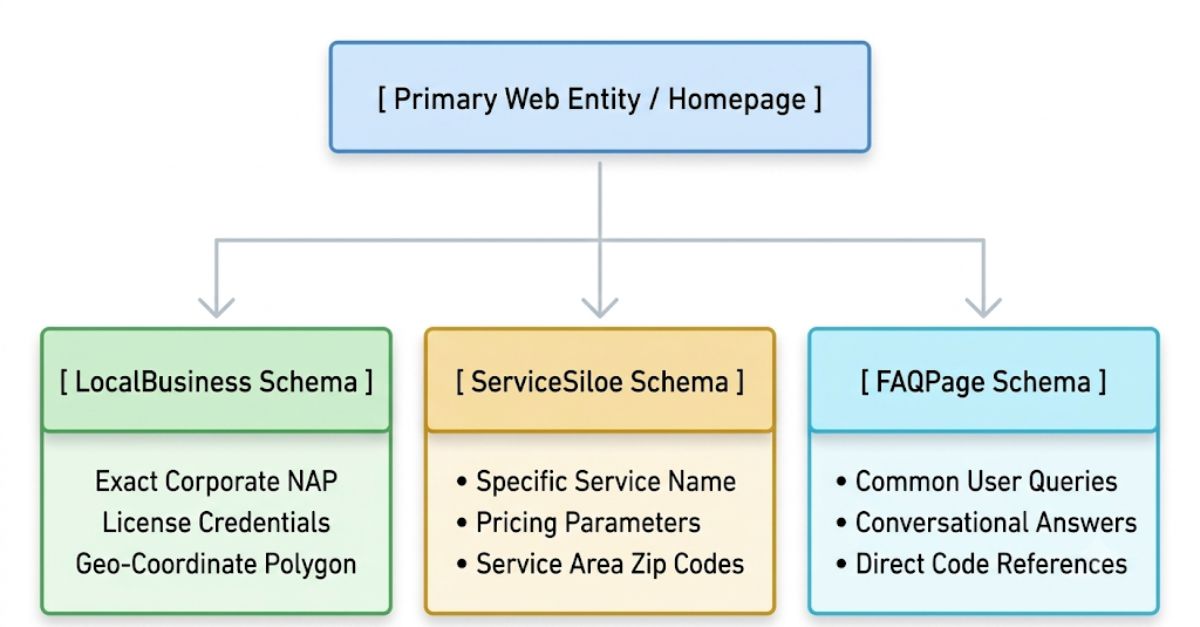
Implementing this structured code layer ensures that when an AI model processes a conversational prompt regarding your industry, it extracts clean, verified facts from your site, elevating your brand’s placement within expert technical SEO frameworks.
How do dedicated service page siloes prevent content cannibalization and establish topical authority?
Lumping all your commercial or residential services onto a single, generic “Services” page damages both traditional SEO rankings and Generative Engine Optimization. Large Language Models evaluate authority based on topical depth and contextual isolation.
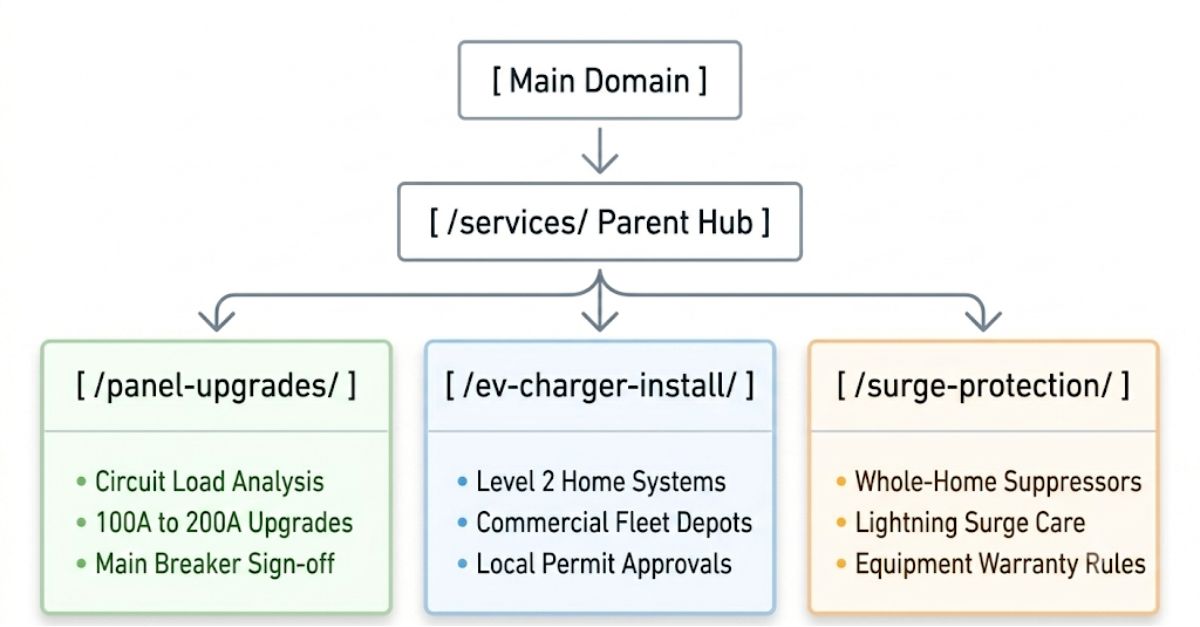
The Blueprint of a Topical Content Silo
A properly designed service silo acts as an authoritative, standalone hub that addresses every sub-topic, building code, and user concern associated with a specific service offering:
Addressing Long-Tail Conversational Search Intents
Isolating topics into dedicated service pages allows your web design team to engineer custom user flows for different intent levels:
- Emergency Conversion Pages: Feature sticky click-to-call bars, real-time technician dispatch availability badges, and instant booking forms tailored for users in immediate crisis.
- Educational Research Pages: Integrate interactive cost estimators, equipment comparison charts, and expandable FAQ accordions designed for homeowners planning future upgrades.
This granular design approach prevents internal pages from competing against one another (keyword cannibalization) while providing generative AI models with the detailed technical context required to cite your business as a top local service provider.
How does conversion-rate optimization (CRO) transform organic traffic into revenue?
Attracting organic traffic from traditional search engines and AI recommendations is only half the battle; your website design must actively turn visitors into paying clients. High traffic numbers coupled with poor conversion rates represent wasted marketing spend.
Conversion-Rate Optimization (CRO) is the discipline of designing website visual flows, micro-interactions, and calls-to-action (CTAs) to eliminate user friction. Aligning user experience design with strategic search optimization ensures that every visitor who arrives on your site is guided toward booking a call or submitting an inquiry.
Reducing Cognitive Friction on Mobile and Desktop
To maximize conversion rates across all device types, your web design must prioritize visual hierarchy and clear interaction paths:
- Place High-Impact Value Propositions Above the Fold: Immediate Orientation.
Ensure the main header immediately communicates who you are, what specific problem you solve, and what geographic area you service within the first 3 seconds of page load.
- Implement Persistent Multi-Channel CTAs: Frictionless Contact.
Anchor a persistent “Call Now” and “Book Online” bar to the bottom of mobile viewports, allowing users to initiate contact at any point while reading.
- Integrate Geotagged Real-Time Review Widgets: Social Proof Anchors.
Embed verified third-party review scores, industry accreditation badges, and authentic job site project photos directly adjacent to contact forms to build immediate trust.
- Streamline Input Fields for Low Friction: Form Optimization.
Reduce scheduling form requirements to 3 or 4 essential fields (Name, Phone Number, Service Needed, Emergency Status) to eliminate drop-offs during submission.
Analyzing Behavioral Heatmaps and Interaction Signals
Continuous CRO requires monitoring how real users navigate your digital properties. Utilizing visual heatmaps, scroll-tracking analytics, and session replays allows your digital agency to identify visual confusion, broken click paths, or high-bounce sections.
Refining these touchpoints through continuous conversion-first design and UX adjustments ensures that your traffic turns into scheduled field service calls and signed contracts.
Why is an omnichannel digital strategy essential for long-term brand authority?
Neither web design nor SEO can achieve maximum performance when executed in isolation. In the modern search ecosystem, search engines and AI models construct a company’s Entity Profile by evaluating its overall footprint across the web.
An omnichannel digital strategy unifies web design, technical SEO, social media, reviews, and content into one consistent brand ecosystem. This integrated presence strengthens business credibility, increasing domain trust across search engines and emerging conversational AI platforms effectively
The Interconnected Digital Ecosystem
To build a resilient brand footprint that withstands search engine algorithm shifts, every digital channel must work in harmony to reinforce your company’s core messaging:
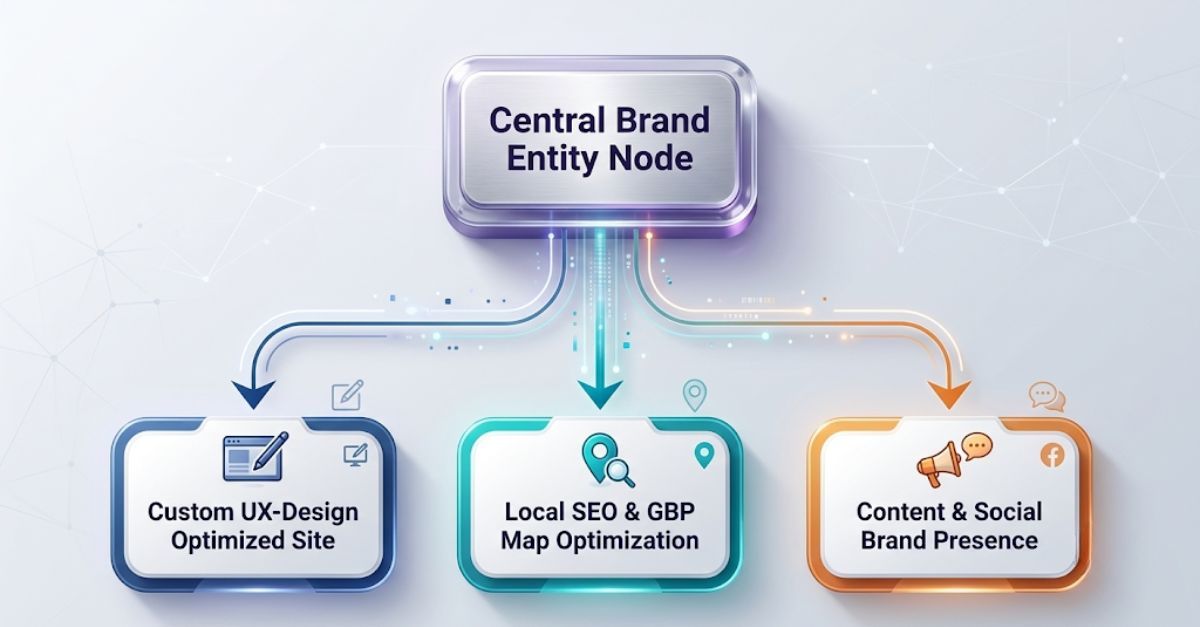
- Custom Web Infrastructure: Serves as your central, high-converting digital storefront, housing structured data and dedicated service siloes.
- Local SEO & Google Business Profile: Drives zero-cost map placements, verifies physical operating coordinates, and feeds local review sentiment into search databases.
- Content & Social Footprint: Broadcasts regular brand updates, educational articles, and project showcases across third-party networks, demonstrating active community engagement.
Frequently Asked Questions (FAQ)
Q: How does Generative Engine Optimization (GEO) differ from traditional SEO in web design?
A: Traditional SEO focuses on optimizing content and backend tags to rank blue links on static search results pages. GEO expands on this by structuring your website’s design, code, and content so that AI-driven answer engines (such as Google Gemini, ChatGPT, and Perplexity) can parse, understand, and directly recommend your business in synthesized conversational summaries.
Q: Why is mobile responsiveness critical for both user experience and technical search rankings?
A: Mobile responsiveness ensures your site adapts seamlessly to any screen size, preventing user frustration and high bounce rates. Because search engines use mobile-first indexing and evaluate real-world mobile Core Web Vitals (such as rendering speed and layout stability), a non-responsive site will be penalized in rankings and excluded from AI recommendation carousels.
Q: How do dedicated service page siloes help establish domain authority?
A: Dedicated service page siloes isolate specific topics, such as “EV Charger Installation” or “Panel Upgrades”, onto individual, highly detailed URLs. This prevents keyword cannibalization, gives search engines unambiguous context, and allows you to build comprehensive content depth that signals strong topical mastery to AI models.
Q: What role does JSON-LD schema markup play in connecting web design with SEO?
A: JSON-LD schema markup is machine-readable code embedded in your site’s backend. It translates your visual design and content into explicit data points (such as legal business name, physical address coordinates, service parameters, and review ratings) that search engines and Large Language Models can index with zero ambiguity.
Q: How does Website Depot combine web design, SEO, and omnichannel marketing to grow my business?
A: Website Depot builds custom, mobile-responsive websites optimized for Core Web Vitals, embeds structured schema networks, and crafts clear service siloes. We then connect your site with targeted local SEO, review management, and content marketing to create a unified digital footprint that attracts traffic, satisfies AI crawlers, and converts visitors into loyal clients.