
How Do Law Firms Drive Growth Through Generative Engine Optimization (GEO) in 2026?
When potential clients face life-altering legal scenarios, such as a serious truck accident, a high-net-worth divorce, or complex corporate litigation, they no longer type fragment keywords into a browser bar.
They prompt AI assistants with detailed, conversational scenarios. GEO builds a machine-readable data network around your firm’s brand entity, establishing the verified domain authority required for LLMs to generate high-confidence recommendations for your practice.
The Mechanics of Algorithmic Entity Synthesis
Traditional SEO focused on matching text on a webpage to keyword density metrics. Modern GEO utilizes Retrieval-Augmented Generation (RAG) loops and vector database matching to construct a holistic Legal Entity Node for your firm. When a conversational assistant processes a prompt, it evaluates three distinct data layers before generating a firm recommendation:
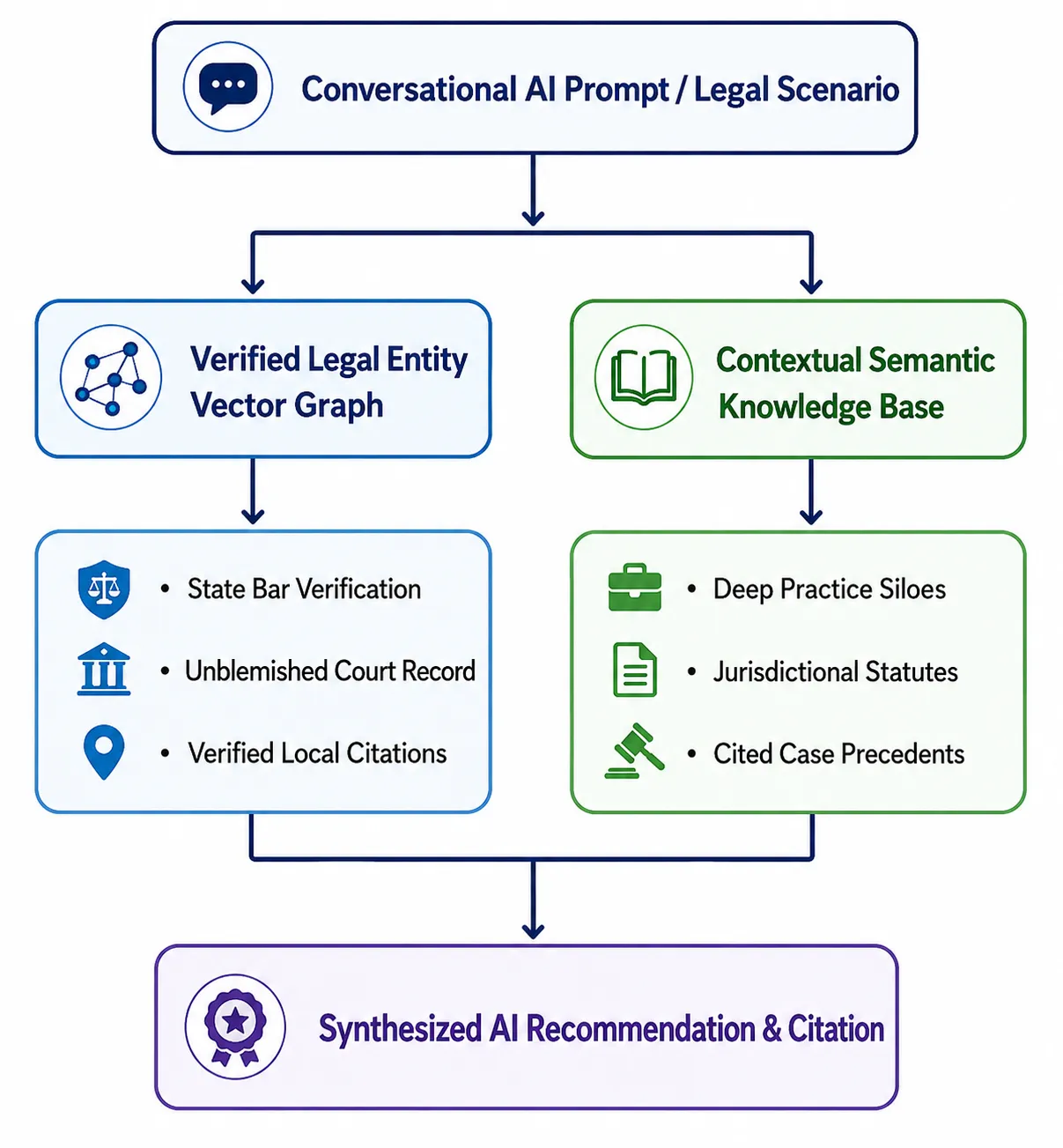
- Verified Entity Identification: Cross-referencing state bar databases, court filing records, and schema markup to confirm your attorneys are licensed, practicing specialists.
- Contextual Semantic Authority: Analyzing your web assets to confirm your site provides deep, unbroken coverage of specific state statutes, local court rules, and case precedents.
- Real-World Reputation Signals: Parsing review sentiment across public directories to confirm client satisfaction and successful case outcomes.
Firms that optimize exclusively for outdated 2020-era SEO tactics risk complete erasure from conversational search feeds. Partnering with a forward-thinking legal marketing agency that understands expert local search engine optimization strategies ensures your firm stays visible across both traditional search layouts and generative AI answer environments.
How do the top law firm digital marketing platforms compare in 2026?
The legal marketing space contains specialized agencies, each employing distinct technical frameworks to capture market share. Selecting the ideal partner requires evaluating how effectively a platform bridges the gap between traditional technical performance and modern Generative Engine Optimization (GEO).
While specialized niche providers focus on rapid local Map Pack dominance, full-funnel growth partners build compounding digital assets that establish long-term domain authority across traditional search engines and AI recommendation models.
Comparative Analysis of Leading Legal Marketing Agencies
Understanding how leading agencies construct, optimize, and scale legal marketing pipelines allows law firm partners to align their retainer investments with clear business metrics:
| Marketing Agency / Platform | Primary Technical Focus | Optimization Methodology | Target Market / Best Suited For |
| LawRank | Niche Legal SEO & GEO | High-Density Content & Local Entity Graphs | Mid-to-large personal injury and criminal defense practices scaling competitive markets. |
| Rankings.io | Technical SEO & Data Analytics | Custom Keyword Tracking & Speed Optimization | High-stakes litigation firms demanding granular technical site architecture. |
| BluShark Digital | Content & Thought Leadership | Comprehensive Pillar Siloes & Authority Content | Multi-practice law firms seeking to dominate informational legal queries. |
| Elite Legal Marketing | Multi-Channel Integration | Combined SEO, Paid Search, & UX Redesign | Practice groups wanting a single, unified digital marketing engine. |
| iLawyer Marketing | Conversion Rate Optimization | A/B Tested Landing Pages & Mobile Funnels | High-value, single-specialty practices looking to maximize consultation rates. |
The Value of Domain Asset Ownership
A critical factor when selecting a legal marketing provider is digital asset ownership. Outdated agencies often rent optimized websites, landing page code, or content structures to law firms. The moment a firm terminates the contract, the agency reclaims the assets, causing the law firm’s search visibility to plummet. We’ve helped attorneys market their business online for a long time.
Modern practices must insist on 100% ownership of all web assets, custom code, copy libraries, and schema configurations created during the engagement. Building proprietary assets under your firm’s domain name ensures every dollar invested creates permanent, equity-building value that lowers your long-term Customer Acquisition Cost (CAC) while establishing permanent brand authority.
Why are dedicated practice area siloes essential for LLM data extraction?
Generic, single-page service summaries destroy a law firm’s ability to capture high-value legal leads. Large Language Models (LLMs) and search crawlers evaluate relevance on an isolated, page-by-page basis.
The Anatomy of an LLM-Optimized Practice Silo
An optimized practice area silo acts as a complete, authoritative knowledge hub that answers every potential question a client or AI assistant might ask regarding a specific legal scenario. This requires moving beyond high-level overviews and detailing local court procedures, statutory deadlines, and liability frameworks:
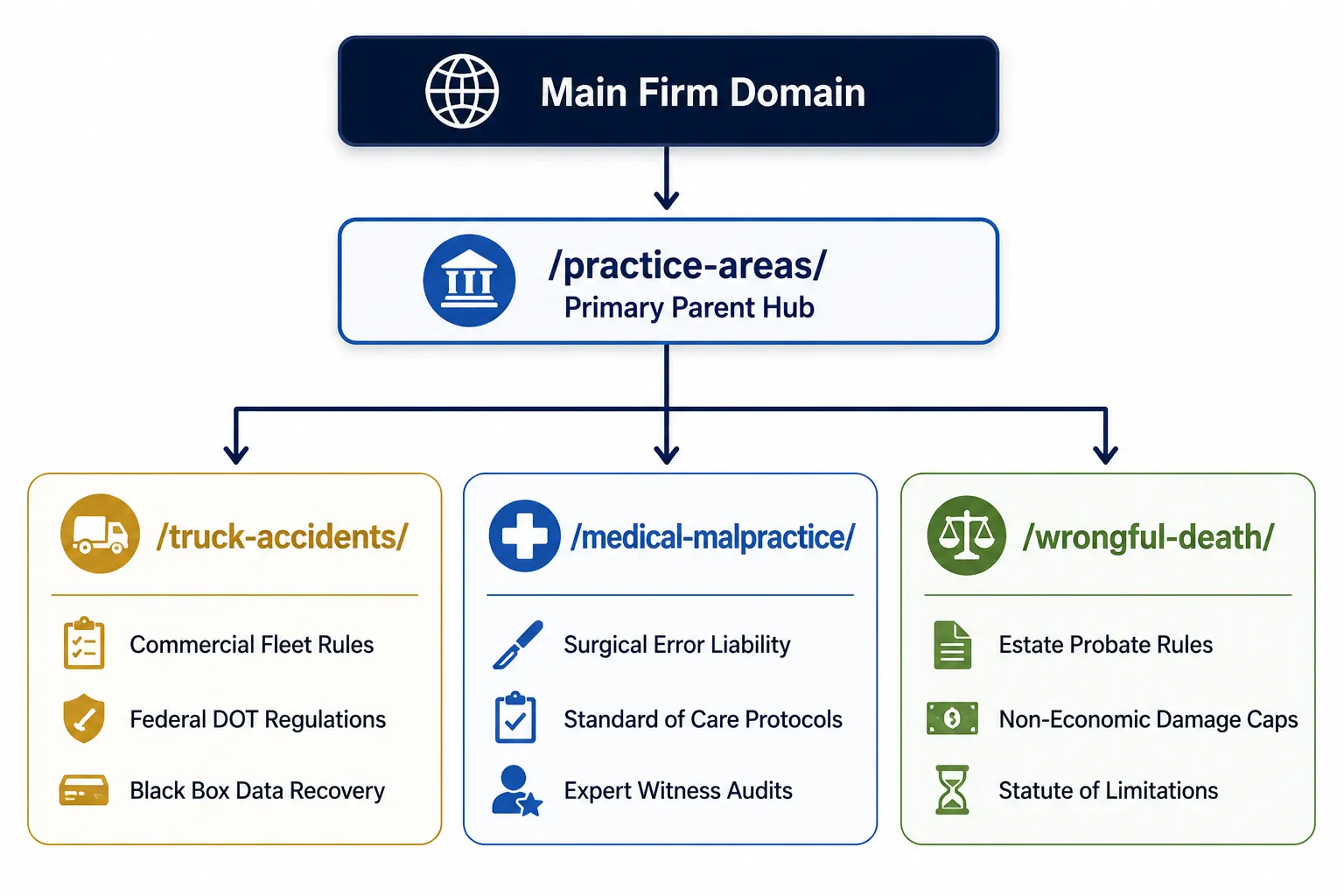
Eliminating Keyword Cannibalization and Information Gaps
When a firm builds individual, deeply researched landing pages for distinct sub-topics (e.g., separating “Commercial Truck Accidents” from “Delivery Van Collisions”), it prevents internal pages from competing against each other in search algorithms.
Furthermore, this granular structure provides the explicit context required by generative AI crawlers. When an AI model processes a prompt asking for “the top-rated attorney in [City] who handles delivery truck collisions involving federal safety violations,” it will pull directly from a firm that maintains a dedicated, comprehensive page covering those exact parameters, bypassing generic competitors and routing warm leads straight to your conversion-first website design.
How does local entity verification and Google Business Profile optimization drive Map Pack dominance?
For consumer-facing practices, such as personal injury, criminal defense, and family law, dominating Google’s local Map Pack and local conversational prompts represents the most profitable lead channel available. Because Map Pack listings sit above traditional organic web links and carry zero per-click cost, they generate the highest-margin phone calls for a firm.
In 2026, local map rankings are driven by entity verification. AI search engines cross-reference your Google Business Profile (GBP) against state licensing registries, physical office records, and unstructured directory citations to confirm your firm is a real, active, and trusted local entity.
Crucial Execution Steps for Local Legal Entity Dominance
- Flawless NAP Uniformity: Your firm’s Name, Address, and Phone number (NAP) must be rendered identically across every legal directory, court document, and bar profile. Minor discrepancies (e.g., “Suite 100” vs. “#100”) degrade AI entity confidence scores.
- Category Precision: Set your primary GBP category to your core practice (e.g., “Personal Injury Attorney” or “Criminal Justice Attorney”). Restrict secondary categories to highly relevant additions to prevent diluting primary ranking power.
- Sentiment-Rich Review Generation: AI models parse the natural language text inside client reviews. Automated review generation systems should encourage satisfied clients to mention specific practice areas, city names, and attorney names in their feedback.
- Geotagged Office Telemetry: Upload photos of your physical office space, building signage, and practicing attorneys directly to your GBP weekly. This visual data stream proves to AI vision models that your firm operates an active physical office rather than an unstaffed virtual mail drop.
Synchronizing your physical office data across verified local networks builds an unshakeable digital footprint that dominates organic map listings and positions your practice to capture high-value cases through targeted local search campaigns.
What backend technical parameters and JSON-LD schema networks do AI crawlers require?
Technical SEO in the era of GEO requires transforming your firm’s website backend into a clean, machine-readable data pipeline. Generative AI crawlers operate under strict computational processing constraints.
The JSON-LD Schema Network Architecture for Law Firms
Schema markup acts as an explicit, machine-readable code layer embedded into your website’s HTML header. It translates human-readable text into structured data points that search engines and LLMs can instantly index without ambiguity:
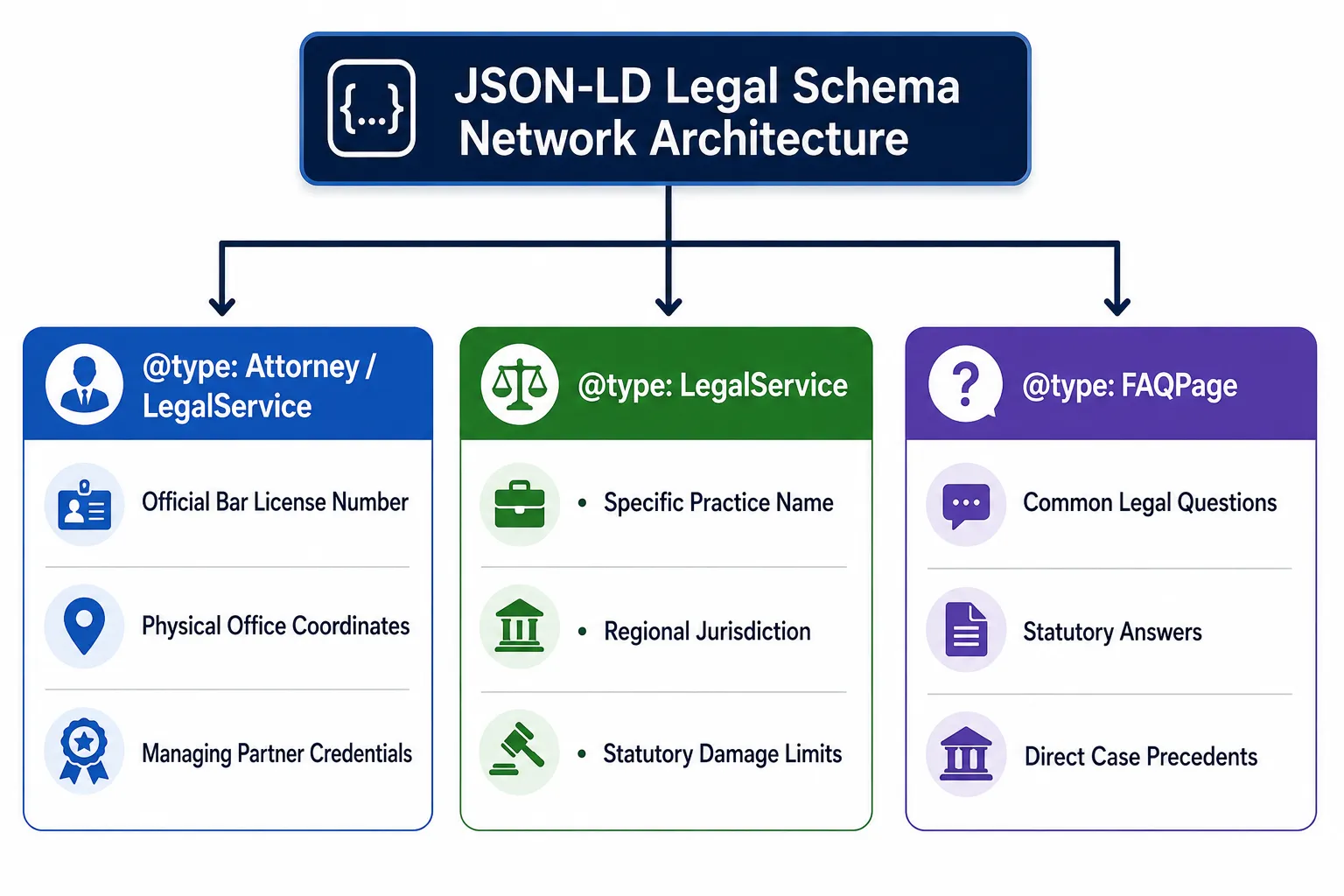
Critical Legal Schema Specifications:
- LegalService / Attorney Schema: Explicitly declares your firm’s official business name, state bar license numbers, physical office location, and primary practice areas directly to machine-learning models.
- Person Schema for Managing Partners: Connects individual attorneys to their law school alma maters, bar admissions, published legal articles, and professional association memberships, building verifiable authority.
- FAQPage Schema: Encapsulates common client questions alongside authoritative answers in a structured format, making it simple for conversational AI tools to pull your exact text into direct answer cards.
Combining structured schema markup with high-speed technical performance, passing all Core Web Vitals parameters, ensures your platform passes automated quality checks, earning sustained placement across technical search engine optimization benchmarks.
How do law firms measure and optimize real-world marketing ROI in 2026?
To build a sustainable legal practice, firm partners must look past superficial metrics like “impressions” or raw “website traffic” and focus on Cost Per Retained Case (CPRC) and Return on Marketing Spend (ROMS). A marketing campaign that generates thousands of low-quality, out-of-jurisdiction form submissions is a drain on your firm’s administrative resources.
A high-performing GEO strategy focuses on attracting high-intent, qualified prospects, reducing your intake team’s workload and maximizing the net fee value generated per signed case.
Metrics for Measuring Legal Growth
Evaluating the true financial return of your marketing investment requires tracking every prospect through the entire client conversion pipeline within an integrated legal CRM (such as Clio, Lawmatics, or Filevine):
[ Raw Inbound Contact ] ──► [ Qualified Consultation ] ──► [ Signed Representation ] ──► [ Net Legal Fee Earned ]
Track Lead Source Filter Non-Cases Calculate CPRC Metrics Calculate True ROMS
| Performance Metric | Calculation Method | Ideal Target Benchmark | Strategic Meaning |
| Cost Per Lead (CPL) | Total Spend ÷ Total Inquiries | Practice Area Dependent ($50 – $250) | Measures top-funnel media efficiency. |
| Consultation Rate | Scheduled Meetings ÷ Total Inquiries | 40% – 60%+ | Evaluates lead quality and intake responsiveness. |
| Sign-Up Rate | Retained Clients ÷ Consultations | 30% – 50%+ | Measures attorney sales presentation and trust. |
| Cost Per Retained Case (CPRC) | Total Spend ÷ Signed Cases | $500 – $2,500 (PI / Lit) | Reveals the true acquisition cost of a client. |
| Return on Marketing Spend (ROMS) | Net Legal Fees Earned ÷ Total Spend | 4:1 to 8:1+ | Demonstrates overall campaign profitability. |
Continuous Optimization and Pipeline Refinement
Takeaways for Firm Partners
- Shift to Entity-Based Marketing: Modern search engines evaluate your firm as a verified legal entity rather than a collection of keywords.
- Insist on Proprietary Asset Ownership: Never rent your website, content libraries, or technical infrastructure from an agency. Build permanent equity under your own domain name.
- Structure Deep Practice Siloes: Isolate specific practice areas and jurisdictional nuances onto dedicated, authoritative landing pages to maximize AI citation rates.
- Track Unit Economics Down to Signed Cases: Evaluate your marketing performance using Cost Per Retained Case (CPRC) and Return on Marketing Spend (ROMS) rather than vanity traffic metrics.