How Does Generative Engine Optimization (GEO) Elevate Email Subject Lines in 2026?
When an email lands in a crowded inbox, an AI assistant evaluates the subject line, preview snippet, sender entity, and underlying metadata to categorize the email as an “Important Summary,” a “Low-Priority Promo,” or “Potential Spam.”
GEO for email marketing is the practice of engineering your subject lines, preview text, and brand entity signals so that Large Language Models (LLMs) and email triage bots recognize your message as high-value, high-context communication. This ensures your email gets prioritized in synthesized inbox summaries rather than filtered into background promotions.
How AI Inbox Assistants Process Email Priority
Modern email platforms do not simply present a list of subject lines; they deploy Retrieval-Augmented Generation (RAG) models to generate real-time visual summaries and priority badges for users.
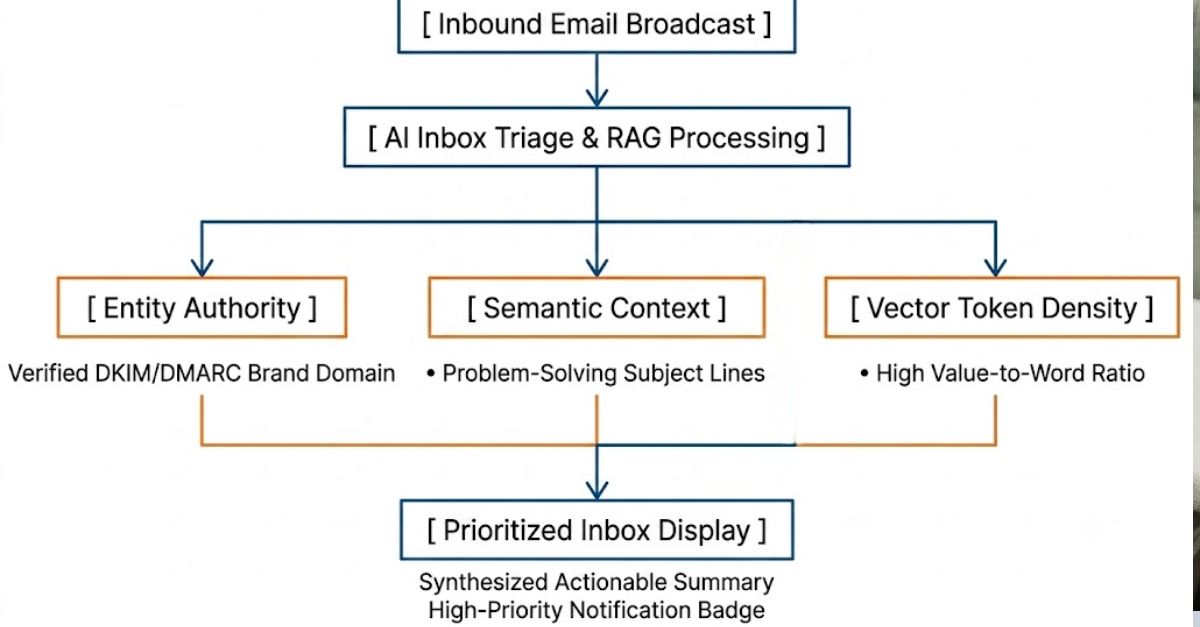
When an AI assistant parses an inbound message, it evaluates three fundamental criteria:
- Semantic Problem-Solving Value: Does the subject line clearly articulate a specific, actionable solution to a known user pain point, or does it rely on vague clickbait?
- Token Information Density: How much meaningful vector data is packed into the first 30 to 50 characters of the subject line?
- Entity Authentication: Is the sending domain backed by strict DKIM, SPF, and DMARC protocols, confirming that the message originates from a legitimate corporate entity?
If an email features a vague, clickbait subject line (e.g., “You won’t believe what happened…”), the AI assistant categorizes it as low-quality filler and suppresses the notification. Implementing conversion-first digital marketing and messaging strategies ensures your subject lines clear automated AI triage filters and capture immediate human attention.
How do AI email assistants parse subject line token density and preview text?
Large Language Models process text using tokens, chunks of characters that convey semantic meaning. Token density refers to how much high-value information is contained within a specific character count. On mobile devices and AI summary cards, subject lines are typically truncated after 30 to 50 characters. You can learn more here from Google.
To maximize open rates in AI-driven inbox environments, marketers must front-load their subject lines with high-density semantic keywords. This provides both the human reader and the AI triage bot with immediate, unambiguous context regarding the email’s core value proposition.
Front-Loading Semantic Value: Traditional vs. GEO Subject Lines
Traditional email marketing often used long, narrative subject lines that placed the core offer or benefit at the end of the phrase. In an AI-filtered inbox, this structure causes the most critical information to be cut off, leading to low priority scoring:
[ Legacy Subject Line: Low Token Density ]
“We wanted to reach out today to let you know about our 20% discount on web tools”
- Result: Truncates on mobile to “We wanted to reach out today…” (Zero Value)
[ GEO-Optimized Subject Line: High Token Density ]
“20% Off Web Automation Tools | Sarah, Your Exclusive Access Ends Tonight”
- Result: Truncates to “20% Off Web Automation Tools…” (High Semantic Value)
The Role of the Preheader (Preview Text) in AI Synthesis
The subject line does not work alone; AI inbox algorithms evaluate the subject line and the preheader text as a single, combined data pair.
| Element | Ideal Character Limit | Strategic Function in GEO |
| Subject Line | 30 – 50 Characters | Hooks human attention with primary benefit; establishes core topic tokens for AI engines. |
| Preheader Text | 50 – 100 Characters | Provides secondary context, promotional specifics, and explicit calls-to-action for AI summaries. |
| Combined Payload | ~120 Characters Total | Forms the complete data payload processed by inbox AI models to assign “Priority” flags. |
By aligning your subject line and preheader text into a unified, high-density data pair, you give AI inbox assistants the exact context needed to generate a compelling, one-sentence preview summary that drives instant opens. Always, we’ve adapted our email marketing to the market and we’ve done the same here.
How does hyper-personalization shift from simple tags to behavioral intent matching?
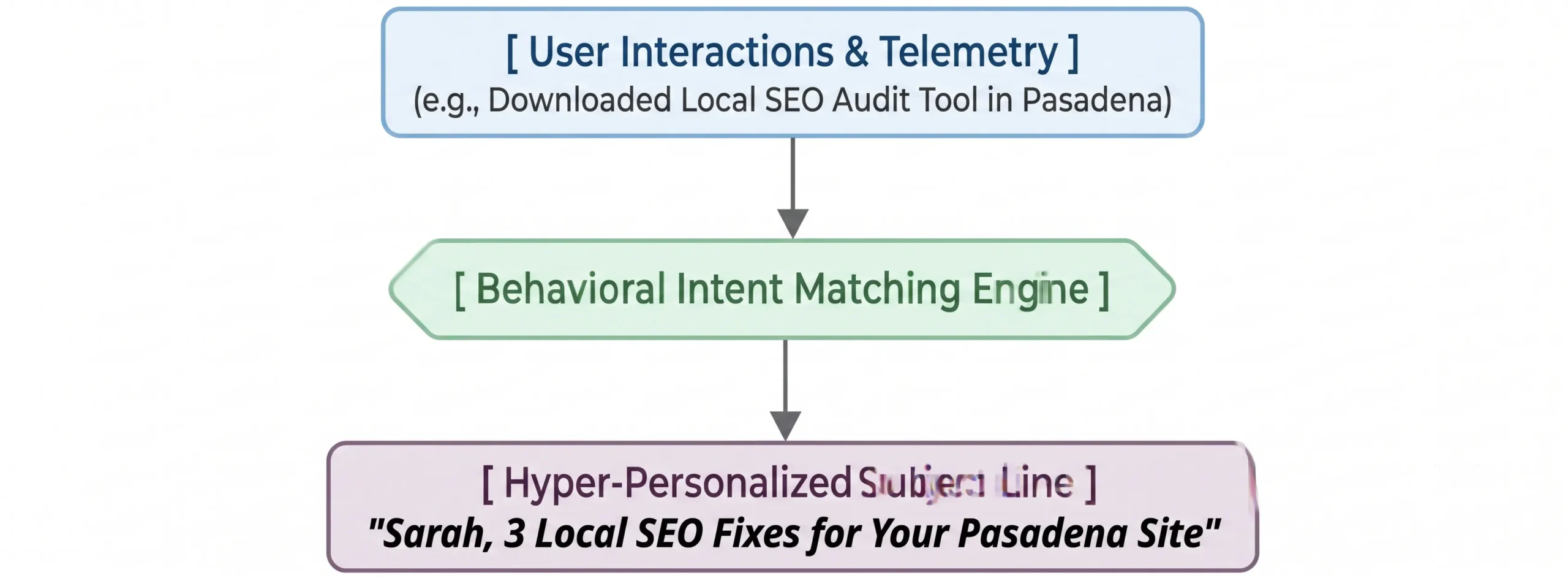
In 2026, basic name-insertion personalization, such as adding [First_Name] to a subject line, is no longer enough to stand out. Human recipients and AI triage filters both recognize basic merge tags as standard marketing automation. Modern GEO personalization relies on behavioral intent matching and hyper-segmentation.
By building subject lines around specific user interactions, such as recent content downloads, software usage milestones, or specific product category views, you demonstrate explicit relevance, dramatically increasing open rates and subscriber engagement.
Advanced Personalization Strategies for Competitive Markets
To achieve peak inbox engagement across competitive B2B and consumer sectors, deployment strategies must move toward contextual relevance:
- Behavior-Triggered Context: Reference real-world actions taken by the user. For example, instead of “Check out our digital marketing services,” use “We noticed you audited your site’s speed, here is the fix.”
- Predictive Value Messaging: Use client CRM data to anticipate upcoming needs, such as seasonal HVAC tune-ups, annual legal compliance checks, or e-commerce subscription renewals.
- Segment-Specific Vocabulary: Adapt the terminology in your subject lines to match the specific industry or interest group of the subscriber (e.g., using technical contractor terminology for home improvement leads versus enterprise metrics for SaaS buyers).
Leveraging these behavioral data structures within data-driven multi-channel localized marketing campaigns ensures your email strategy consistently delivers messages that feel crafted for the individual recipient.
Why does urgency and curiosity marketing trigger automated spam filters in AI models?
While urgency and curiosity are classic psychological triggers used to boost open rates, overusing them in 2026 carries a severe deliverability risk. Modern inbox platforms use AI-driven natural language understanding (NLU) to detect manipulative, misleading, or deceptive framing.
If a subject line relies on false urgency (e.g., “URGENT: Your account is closing!!!”) or extreme clickbait curiosity (e.g., “You won’t believe this secret…”), automated AI spam filters penalize the sender’s domain trust score, routing the message to the spam folder or low-priority promotional tabs.
Balancing Psychological Engagement with Deliverability Safety
To maintain high open rates without triggering automated spam disincentives, marketers must replace artificial clickbait with authentic, value-driven urgency:
- Eliminate High-Risk Spam Trigger Phrases: Audit Phase.
Scan subject lines to remove aggressive capitalization, excessive punctuation (e.g., “???”, “!!!”), and traditional spam keywords like “100% Free,” “Earn Money Fast,” or “Act Now.”
- Replace False Urgency with Explicit Deadlines: Refinement Phase.
Transition from vague pressure tactics to clear, factual constraints. Replace “Last Chance Ever!” with clear parameters like “Flash Sale: 20% Off Ends at Midnight PST.”
- Transform Clickbait into Problem-Solving Curiosity: Framing Phase.
Reframe open questions to promise tangible value. Instead of “The Secret We Kept Hidden,” use “3 Schema Errors That Slow Down Mobile Rankings.”
The Mechanics of Domain Reputation Management
Email inbox platforms assign a continuous Sender Reputation Score to your domain based on recipient interactions, spam complaints, and subject line authenticity. If subscribers open an email due to a misleading subject line and immediately delete it or mark it as spam, inbox AI models learn to penalize future broadcasts from your domain.
Protecting your sender infrastructure through regular list hygiene and warming tools, like QuickMail Autowarmer, ensures your campaigns maintain top-tier deliverability ratings across all major email providers.
How do A/B testing and AI iterative models optimize subject line performance in real time?
Crafting high-converting subject lines is an iterative science rather than a one-time creative exercise. Advanced email marketing frameworks deploy AI-powered real-time A/B testing. Rather than manually sending two subject line variations to an entire list, automated platforms send small test batches, evaluate initial AI inbox priority scoring and human open rates, and automatically deploy the winning variation to the remaining audience segment.
This continuous optimization loop ensures that your primary audience receives the subject line variant that has statistically proven to overcome inbox noise.
Framework for Programmatic Subject Line A/B Testing
When executing A/B tests across competitive commercial markets, isolate a single testing variable per campaign to gather actionable performance data:
| Test Variable | Variant A (Control) | Variant B (Test Variable) | Strategic Insight Captured |
| Format Structure | “5 Tips to Improve Mobile Page Speed” | “How to Fix Slow Mobile Load Times in 5 Steps” | Measures preference for listicles versus procedural problem-solving phrases. |
| Personalization Type | “Sarah, Exclusive Marketing Deals Inside” | “Exclusive Marketing Deals for Pasadena Businesses” | Tests individual name insertion against regional demographic relevance. |
| Tone & Style | “Save 30% on Annual Agency Retainers” | “Ready to Scale Your Lead Volume This Quarter?” | Evaluates direct financial discounts versus value-oriented business growth prompts. |
| Emoji Usage | “New SEO Audit Tools Are Live” | “New SEO Audit Tools Are Live 🚀” | Determines if visual indicators lift CTR or trigger promotional tab sorting for your specific audience. |
Analyzing Behavioral Signals Beyond Open Rates
While open rate is the primary metric for subject line performance, modern GEO analytics also track Read Time, Click-Through-Rate (CTR), and Unsubscribe Velocity. If a subject line generates a high open rate but a high unsubscribe rate, it indicates a mismatch between the promise made in the subject line and the content delivered in the email body.
Aligning your messaging architecture ensures that your campaigns drive immediate opens while cultivating long-term brand equity. That’s true whether you’re an attorney, a home improvement contractor, or in practically any other industry.
What technical delivery parameters (DKIM, SPF, DMARC) ensure email subject lines reach the main inbox?
Even the most perfectly crafted, GEO-optimized subject line is useless if your email never reaches the primary inbox. Technical deliverability forms the underlying foundation of email marketing. In 2026, major inbox providers enforce strict authentication protocols.
If your sending domain lacks proper SPF (Sender Policy Framework), DKIM (DomainKeys Identified Mail), and DMARC (Domain-based Message Authentication, Reporting, and Conformance) records, your emails will be flagged as unverified and diverted directly to spam or junk folders, regardless of subject line quality.
The Technical Deliverability Stack for Modern Marketers
To guarantee that your emails pass security filters and reach recipient inboxes reliably, your technical infrastructure must maintain three core authentication layers:
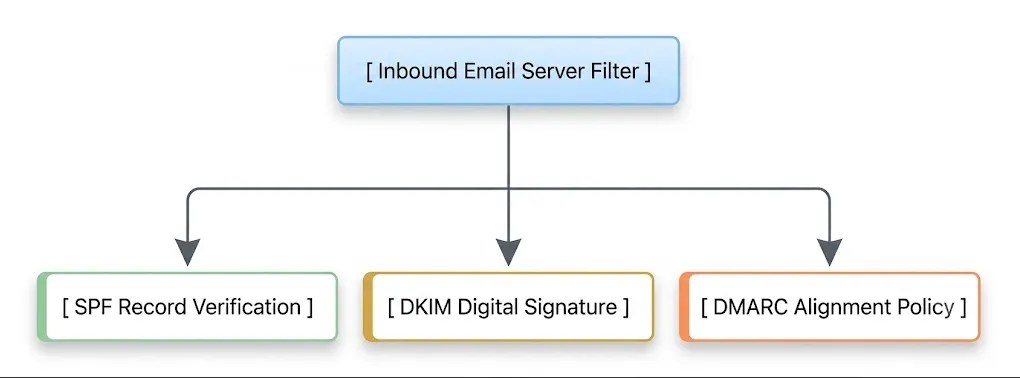
Validates IP server authority Verifies email content integrity Enforces domain security rules
- SPF Record Configuration: A specialized DNS TXT record that explicitly identifies which mail servers and IP addresses are authorized to send email on behalf of your domain name.
- DKIM Cryptographic Signatures: Adds an encrypted digital signature to every outgoing email header, proving to receiving mail servers that the email content was not tampered with or altered during transit.
- DMARC Policy Enforcement: Leverages SPF and DKIM checks to instruct receiving mail servers on how to handle unauthenticated emails (e.g., applying a p=reject or p=quarantine policy), protecting your domain from spoofing and phishing attempts.
Maintaining List Hygiene and Low Bounce Rates
In addition to cryptographic security, maintaining a clean subscriber list is vital for deliverability. High hard-bounce rates (caused by sending emails to invalid or defunct addresses) signal to inbox algorithms that your domain engages in poor list management practices.
Utilizing real-time email verification services and implementing double opt-in registration processes ensures your list remains clean, protecting your sender score and guaranteeing that your high-converting subject lines consistently land in front of active decision-makers.