Google on Schema: An SEO/AEO Analyst’s Guide to LLM Visibility
Search has entered a transitional era where traditional ranking signals intersect with large language models, entity recognition, and AI-driven summaries. At Website Depot, we see this shift daily across campaigns that must now perform for both human users and machine readers. From the perspective as an SEO/AEO analyst, Schema is no longer a “nice-to-have” technical enhancement.
Recent commentary from Google’s John Mueller has added clarity and nuance to how Schema fits into this new environment. It is a structured communication layer between your brand and the systems that interpret, summarize, and cite content at scale.
What John Mueller Said: How Google and LLMs Actually Read Your Site
According to Search Engine Roundtable, John Mueller has repeatedly emphasized that Google and modern LLMs can technically read raw HTML. The distinction is efficiency and precision. HTML provides context. Schema provides certainty.
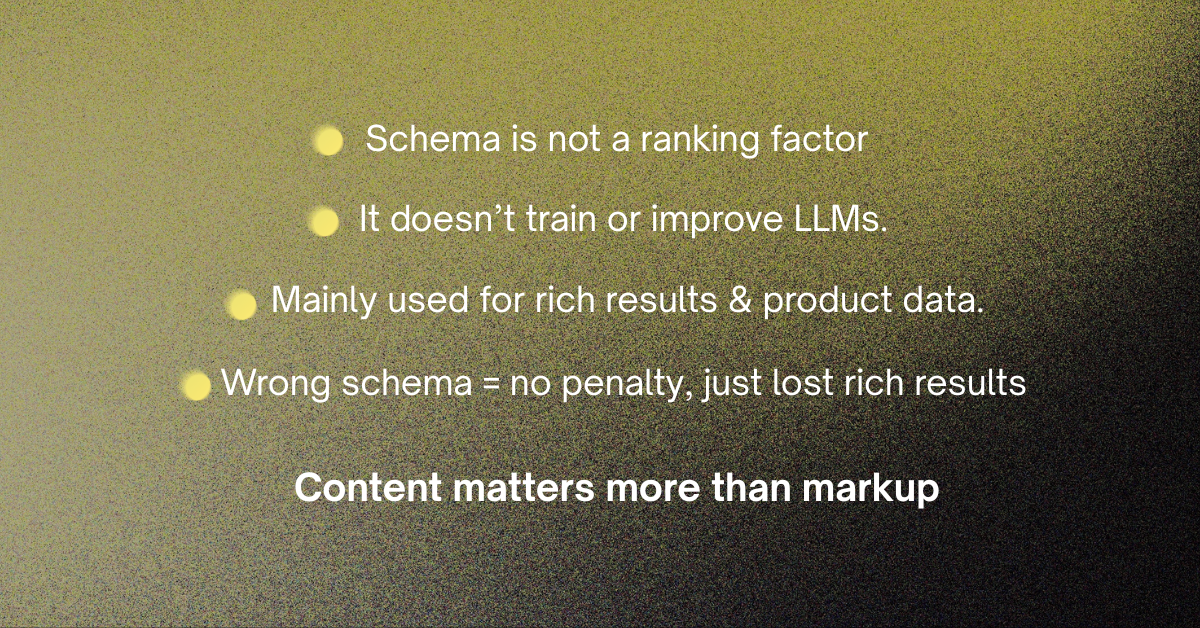
Mueller’s remarks, shared in discussions around whether Schema helps with LLMs, reinforce what we implement across our omnichannel strategies: Schema does not guarantee visibility, but it dramatically improves how clearly your data is interpreted.
In a search ecosystem increasingly shaped by AI Overviews and synthesized answers, clarity is currency. As an SEO/AEO analyst, our role is to ensure your brand is legible, attributable, and quotable across these emerging interfaces.
From our work in technical optimization, we see Schema functioning as a fast lane for machine parsing. Instead of inferring meaning from page layout and copy structure, systems can directly access labeled data points.
This matters most for details that require accuracy, such as:
- Pricing and offer conditions
- Product availability states
- Shipping parameters
- Business identifiers
- Author credentials
Mueller’s position aligns with what we observe in practice. Schema does not replace high-quality content or sound site architecture. It supplements them by reducing ambiguity. That reduction in ambiguity is what enables consistent AI interpretation across platforms, not just Google Search.
Schema as a Machine-Readable Trust Layer
Schema’s real value is not about visual enhancements or rich results alone. It is about building a trust layer that machines can rely on when summarizing or citing information.
In our digital marketing, we deploy Schema as a form of declarative data. It tells systems exactly what a page represents, who created it, and how it should be categorized.
That approach supports:
- Faster data extraction by crawlers
- More consistent entity association
- Clear attribution signals for AI summaries
- Reduced risk of misclassification
When Schema is implemented strategically, it allows your content to be evaluated with less guesswork. As an SEO/AEO analyst, we treat this as a foundational step for AI-facing visibility rather than a ranking tactic.
Entity-First Optimization in an AI Search World
Mueller’s commentary reinforces a broader shift: Schema is less about rankings and more about identity. Search engines and LLMs increasingly rely on entity graphs to connect people, brands, topics, and credentials.
Our team structures Schema to reinforce entity relationships, not just page attributes. This includes aligning Organization, Person, Product, and Service entities across the site so that your brand is consistently represented.
Entity-focused Schema supports:
- Clear differentiation from similarly named brands
- Stronger association with topical expertise
- Improved citation likelihood in AI Overviews
- Better alignment across knowledge systems
From the perspective of an SEO/AEO analyst, this is how you tell an AI system, “This is who we are, and this is what we are known for,” without relying on inference.

The “It Depends” Reality Behind Schema and Rankings
One of the most valuable aspects of Mueller’s guidance is its honesty. Schema does not automatically push a page to the top of results. There is no hidden ranking multiplier attached to structured data.
We approach this reality with transparency when working with clients. Schema is a support system. It works best when paired with:
- Clear topical focus
- Consistent publishing standards
- Accurate on-page information
- Clean technical foundations
Our goal is not to promise instant gains. It is to build assets that AI systems can confidently reference. That credibility compounds over time, especially as search interfaces rely more heavily on summarized responses.
Zero-Click Search and the Long Long Tail
By 2026, more than 60% of searches are triggering AI Overviews or similar synthesized results. This has reshaped how visibility is earned. Clicks still matter, but citations and mentions now play a parallel role.
In local SEO campaigns, we see this shift most clearly in query patterns. Broad questions are answered instantly. Specific, nuanced questions are summarized using multiple sources.
This is where Schema and long-tail strategy intersect. We focus on helping clients address highly specific queries that AI systems prefer to summarize rather than ignore.
That includes content designed to answer:
- Conditional scenarios
- Industry-specific edge cases
- Comparison-driven questions
- Process-oriented inquiries
From an SEO/AEO analyst standpoint, being citable is as valuable as being clickable.
Schema’s Role Across Omnichannel Services
At Website Depot, we integrate Schema into the services we already provide, ensuring it supports broader marketing objectives rather than operating in isolation.
Within SEO home improvement campaigns, for example, structured data helps clarify service areas, project types, and contractor credentials. This improves how AI systems contextualize expertise in a crowded vertical.
For social media marketing, Schema supports consistency. When content is shared, referenced, or repurposed across platforms, structured data reinforces brand identity and content ownership at the source.
Our Schema implementations are designed to align with:
- Technical SEO initiatives
- Content strategy development
- Analytics and performance tracking
- Cross-channel brand messaging
How We Implement Schema for LLM Visibility
Our process is built around precision and restraint. Overuse or misapplication of Schema can be as harmful as not using it at all.
We focus on:
- Selecting Schema types that reflect actual content
- Avoiding speculative or unsupported markup
- Aligning structured data with visible page elements
- Maintaining consistency across templates
This disciplined approach supports long-term credibility. AI systems are becoming better at detecting mismatches between structured data and on-page reality. As an SEO/AEO analyst, accuracy is non-negotiable.
Where the Right SEO/AEO Analyst Fits Going Forward
As search evolves, the role of the SEO/AEO analyst becomes more interpretive and strategic. It is no longer just about optimizing for blue links. It is about shaping how machines perceive, trust, and reuse your content.
Our work focuses on:
- Translating business value into machine-readable signals
- Supporting AI systems without chasing algorithms
- Building durable visibility across changing interfaces
Schema is one of the most effective tools available for this task when applied thoughtfully. We see it as a language layer. Specifically, it’s one that allows your brand to speak clearly in an increasingly automated search landscape.